Current-state workflow map
A traceable view from trigger to accepted output, including systems, actors, decisions, workarounds, and unresolved assumptions.
Map one critical workflow, assign its decision ownership, and leave with a rehearsable 30-day transfer blueprint. Make the hidden operational decisions visible and use a supervised rehearsal to decide what transfers next.
Instructions may exist, but a capable operator still needs live founder context to know which path applies, what to prioritize, or what “done” means.
Tasks move to the team while approvals, tradeoffs, and unusual cases continue to route through one person. Activity transfers; judgment does not.
A checklist, knowledge base, and project board can each contain part of the truth. Without a version owner and acceptance evidence, the team cannot tell which rule governs.
Define the trigger, accepted end state, actors, systems, inputs, outputs, exclusions, and one normal and exception path.
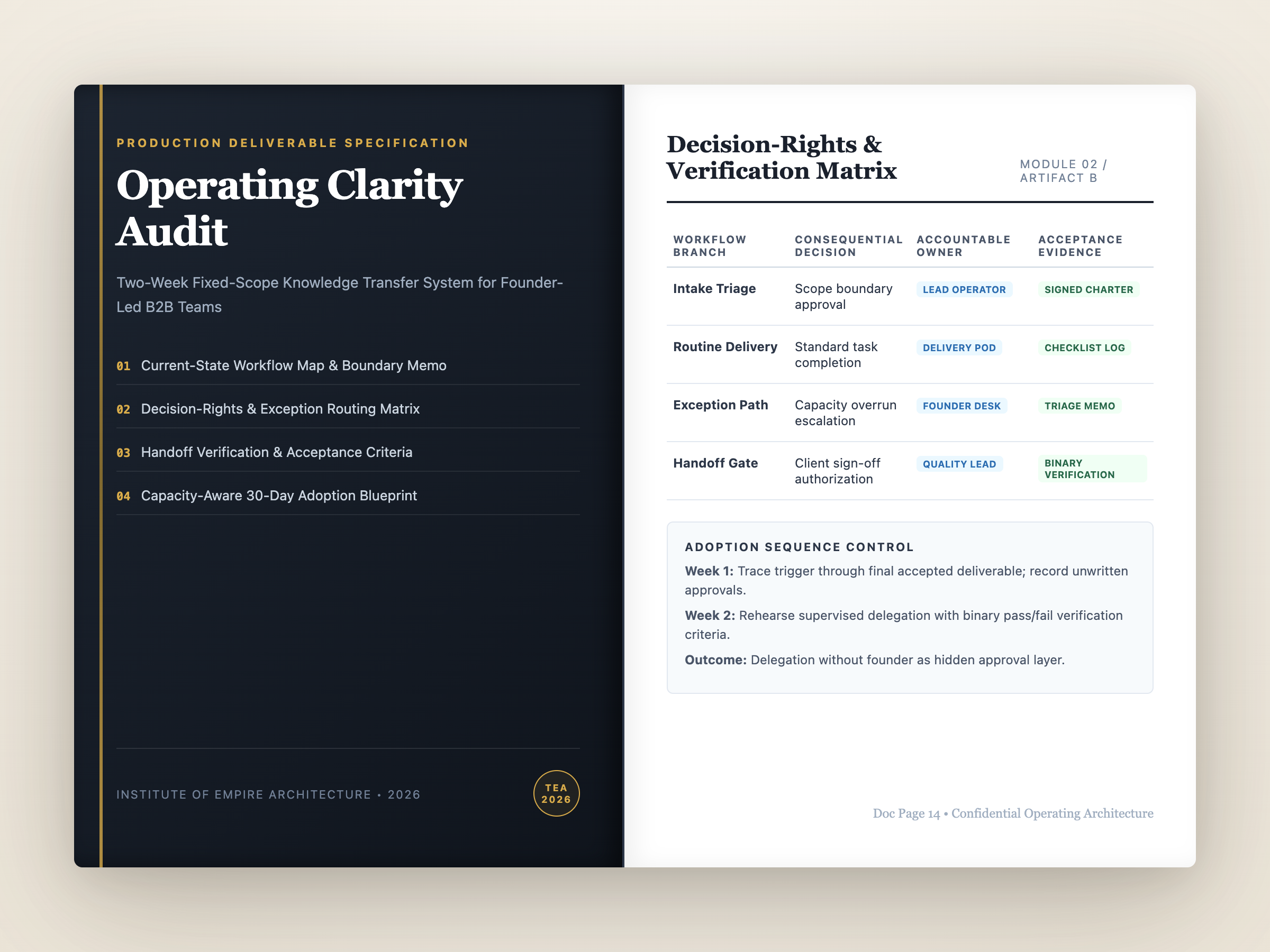
Give each consequential decision one accountable owner, required evidence, response window, and escalation condition.
Replace subjective quality language with observable acceptance rules, reviewers, evidence locations, failure responses, and retests.
Order reversible changes inside 24 weekly founder hours, with review dates, stop conditions, and rollback actions.
A traceable view from trigger to accepted output, including systems, actors, decisions, workarounds, and unresolved assumptions.
One accountable owner for each consequential branch, with required inputs, response windows, escalation conditions, and decision evidence.
Observable quality rules, reviewers, evidence locations, defect responses, and retest requirements for every critical output.
A controlled place for non-standard cases, conflicting instructions, disposition decisions, authoritative versions, and follow-up dates.
A capacity-aware sequence of owners, dependencies, hour budgets, review events, stop conditions, and rollback actions.
No replacement claim is made. The audit clarifies workflow boundaries, decision authority, acceptance evidence, and role requirements so the staffing decision has a stronger operating basis.
Existing documents become inputs. The audit tests whether they also establish decision owners, exceptions, authoritative versions, and accepted outputs.
Start with a boundary test: one important workflow, an identifiable trigger and accepted end state, a participating process owner, and available source artifacts.
Only the written scope, delivery artifacts, review events, acceptance evidence, and contractual remedies can be committed. No business-performance outcome is promised.
Days 1–3 establish scope and current state. Days 4–7 map decisions, exceptions, and acceptance rules. Days 8–10 assemble the implementation sequence, run rehearsals, reconcile the artifacts, and deliver the release package.
A process owner, the relevant workflow artifacts, scheduled interview and review time, and authority to confirm decision ownership. Regulated or unnecessary data should not be supplied.
Company-wide transformation, ongoing operations management, legal or tax advice, custom software implementation, and unbounded documentation work are excluded unless separately scoped.
For $1,800/month, the planning scope includes two implementation reviews, decision-log analysis, exception triage, and blueprint revision within 6 provider hours.
The blueprint schedules Day-7, Day-14, Day-21, and Day-30 decisions. Each review uses acceptance evidence and stop conditions to continue, revise, narrow, or pause.
Review one workflow boundary, the required access, five deliverables, investment assumptions, capacity, and acceptance terms. The decision may be proceed, narrow, defer, refer, or decline.
Direct operational communication only. No third-party data sharing.